Collecting feedback at scale solves one problem and creates another. Once responses are coming in consistently, teams often find themselves staring at a long, mixed list with no clear starting point. This article offers a practical framework for sorting feedback into tiers — immediate action, roadmap input, and passive monitoring — based on three factors that most teams already track but rarely combine.
The pile-up problem no one warns you about
Most feedback programs are designed around collection. The forms, the NPS surveys, the post-session prompts, the open-text fields — the entire infrastructure points toward gathering more signal.
What happens after is less designed.

Responses arrive. Some are urgent. Some are vague. Some repeat a frustration the team has heard for months. Some are genuinely new. A few seem contradictory. And because there is no standing framework for sorting them, many teams default to recency — handling whatever came in most recently, or whatever someone loud enough escalated first.
That is not a prioritization system. It is a queue.
The result is that high-impact problems sit alongside low-signal noise, and the team treats them with similar urgency simply because they arrived around the same time.
Three dimensions that actually matter
A more useful framework does not start with the feedback itself. It starts with three questions that apply to any piece of feedback before you decide what to do with it.

1. Who is this coming from?
Not all customers carry the same weight, and that is not a cynical observation — it is a practical one. Feedback from high-retention customers, recently converted visitors, or users deep in the journey carries different implications than feedback from someone who browsed once and never returned. This is not about ignoring anyone. It is about understanding whether a signal represents a pattern in the segment you care most about.
2. How often does this come up?
Frequency matters more than intensity, at least for structural decisions. A single strong complaint deserves follow-up. A mildly worded frustration that appears fifteen times a week deserves investigation. Frequency is one of the clearest signs that something in the experience is creating a consistent friction point, not just a one-off.
3. What does it take to resolve?
Some feedback points to a messaging fix that takes a day. Some points to a product limitation that takes a quarter. That distinction belongs in the prioritization logic from the beginning — not as a reason to deprioritize important issues, but as a way to route feedback into the right process.
The three-tier model
Once those three questions are answered, most feedback falls into one of three tiers.
Tier 1 — Act now
Feedback that belongs here typically meets two or more of these conditions:
- Comes from your most valuable or highest-intent customer segment
- Has appeared multiple times in a short window
- Points to a resolution that is within reach quickly
The classic Tier 1 example is repeated confusion about a specific step in the conversion flow, reported by customers who are clearly evaluating seriously. That combination is not ambiguous. It suggests something is creating hesitation at exactly the wrong moment, and it is worth stopping other things to address.
Tier 2 — Feed into planning
Tier 2 feedback is real and important but does not warrant interrupting current work. It typically:
- Reflects a recurring theme without acute urgency
- Requires meaningful development or structural change to resolve
- Comes from a segment that matters but is not in immediate jeopardy
This is where a lot of product roadmap input comes from. The frustration is valid, the pattern is real, and the right home for it is a structured planning conversation — not a reactive fix.
Tier 3 — Monitor passively
Some feedback does not yet warrant action or planning. It is useful to retain and watch, but not to route into any active workstream. This includes:
- One-off signals without corroborating evidence
- Feedback from users who fall outside your core segment
- Issues that are known and intentionally deprioritized for now
Tier 3 is not a graveyard. It is a holding pattern. Signals move out of it when frequency increases, when segment fit changes, or when a resolution path becomes feasible.
Where the framework breaks down without shared definitions
The model above is straightforward in structure, but it only works if the team agrees on what “high-value customer” means, what qualifies as “frequent enough,” and who has authority to make Tier 1 calls.
Without that agreement, the same piece of feedback will get sorted differently by different people. One person sees an urgent signal. Another sees edge-case noise. And the team ends up back where it started — using instinct and availability rather than logic.
This is worth a short internal conversation before the framework gets used in practice. The categories are less important than the shared criteria behind them.
Putting it into motion
A useful first pass through your current feedback backlog might look like this:
- Pull the last four to six weeks of responses
- Tag each by segment, resolution complexity, and approximate frequency
- Sort into the three tiers based on that combination
- Identify anything that has been sitting in Tier 1 territory without being treated that way
The sorting itself often surfaces surprises. Patterns that felt vague become clearer when frequency is made visible. Issues that seemed urgent turn out to be one-off. A few things that were being quietly ignored turn out to meet all three criteria for immediate action.
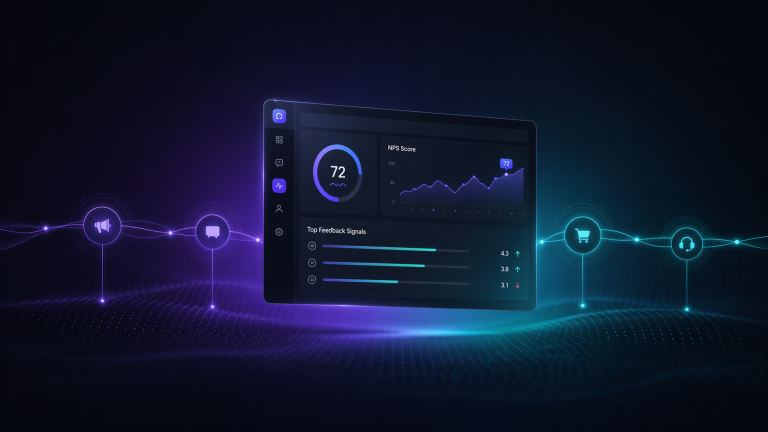
That is where products like Insightto.ai can help — not by making the framework decisions for you, but by connecting survey responses to page journey context, making it easier to see how frequently a signal appears, which segments it clusters in, and what visitors were doing before they reported it. Faster pattern recognition means less time sorting manually before the real prioritization conversation can happen.
The honest version of progress
No framework removes judgment. Some feedback will still be hard to categorize. Some Tier 2 issues will feel emotionally urgent even when they logically are not. Some Tier 3 signals will turn out to matter more than they looked at first.
What a prioritization framework does is give the team a common starting point. Everyone works from the same logic, even when they disagree on the outcome. That alone moves the conversation forward faster than any amount of extra data collection.
The bottleneck is rarely signal volume. It is the gap between receiving feedback and knowing, with some confidence, what to touch first.