When teams say NPS is not telling them much, they usually blame the question.
The score feels broad. The feedback sounds vague. The responses are hard to use. So the assumption is that the metric itself is too limited to be worth much.
That is not always wrong. But a lot of weak NPS programs start failing before anyone reads the result.
The survey was sent at the wrong moment.
Timing changes what the answer means
That matters more than most teams admit.
Ask too early and the customer has not experienced enough to answer with any substance. Ask too late and the response gets filtered through whatever happened afterward, or through a general impression that no longer maps cleanly to the moment you wanted to understand.
The score still arrives either way. What disappears is the context that would have made it useful.
People do not usually answer NPS in some abstract, brand-level way. They answer from what still feels recent enough to shape their judgment. In a digital journey, that may be a pricing page, a repeat visit, a signup attempt, a support interaction, or a point where the experience suddenly felt heavier than expected.
When the survey lands close to that moment, the signal gets sharper. The number is easier to interpret. The written feedback usually becomes more specific too.
Poor timing creates predictable problems
Bad timing tends to create the same kinds of distortion.
One is that the response becomes detached from the experience you were trying to measure. Another is that feedback gets generic. A third is delay: by the time dissatisfaction becomes visible, the customer may already be cooling off or leaving.
There is also a quieter problem. Poor timing can make a feedback program look healthier than it really is. Teams may be collecting valid scores while missing the exact moments where confidence is breaking down.
This shows up a lot when surveys are sent on fixed schedules simply because fixed schedules are easy to manage. Quarterly sends look neat on an internal calendar. Customer judgment does not form on a neat calendar.
In ecommerce and page-based journeys, timing is part of the method
This gets even more obvious in ecommerce and product-led journeys.
A visitor who just spent time on a pricing page is in a very different mental state from someone who bounced off the homepage. A person who came back three times has more formed judgment than someone who barely engaged once. A user who just completed a meaningful step can answer in a grounded way. Someone who has not yet reached the decisive moment usually cannot.
This is where timing stops being an operational detail and becomes part of the method.
Better timing does not change the NPS question itself. It puts the question closer to the experience that shaped the answer.
AI helps make timing less arbitrary
This is one of the more grounded ways AI improves feedback programs.
The value is not that AI makes the survey smarter in some magical sense. The useful part is that it helps teams stop triggering outreach at arbitrary moments. Instead of sending surveys because the calendar says it is time, teams can ask when behavior suggests the customer has actually reached a meaningful point.
That may be after a repeat visit, after visible hesitation, after a high-intent page sequence, or after a key step in evaluation.
Once timing improves, interpretation improves too. A low score after several pricing visits tells one story. A low score after a rough onboarding moment tells another. The tighter the link between response and experience, the less guesswork the team has to do later.
Better timing changes the role of NPS
When teams improve timing, NPS starts functioning differently.
It stops being just a recurring health score and becomes more of an operational signal. The conversation shifts from “What is our score this month?” to “What are people reacting to, and where is that reaction forming?”
That is a much more useful question.
Where a product like Insightto.ai fits
This is also where a tool like Insightto.ai becomes relevant in a very practical way.
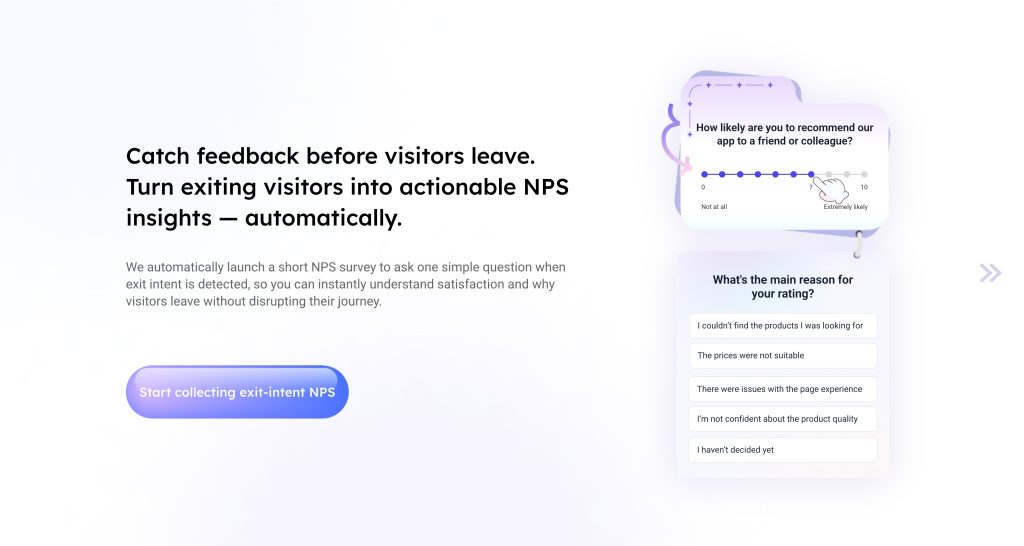
If teams can trigger surveys at moments that actually matter, read feedback next to page journey context, and see when hesitation is building, then NPS becomes more informative without becoming more complicated.
A lot of teams do not need a new metric.
They need better timing.