NPS has been around long enough that many people have developed a fixed opinion about it.
Some still treat it as the default way to measure customer loyalty. Others dismiss it as too simplistic to be useful. Neither reaction is entirely wrong. NPS is simple, and that simplicity is part of both its strength and its limitation.
What matters is not whether NPS is universally good or bad. What matters is how it is being used.
When teams expect it to explain everything, it disappoints. When they use it carefully, in the right context, it can still be one of the clearest lightweight signals in a customer experience program.
NPS is not supposed to do every job
A lot of frustration with NPS comes from asking it to carry too much weight.
It is a recommendation question, not a complete diagnostic system. It can tell you something about loyalty, perception, and the overall direction of the relationship. It cannot, on its own, tell you the full reason behind a customer’s score, nor can it replace journey analysis, support data, product analytics, or direct research.
When teams forget that, NPS starts looking shallow. They expect one score to explain a complicated experience, and when it does not, they conclude the metric itself is flawed.
But that is not really the test.
The more useful question is whether NPS can help a team notice changes in customer sentiment, compare patterns over time, and identify where deeper investigation is needed. Used that way, it still holds up surprisingly well.
Simplicity is part of why it survives
One reason NPS continues to matter is precisely because it is simple.
It is easy to deploy. Easy to understand. Easy to repeat across time. That does not make it sophisticated, but it does make it usable across teams that would never adopt a more complex experience measurement model consistently.
That matters in real organizations. Most companies are not operating with ideal research conditions. They need signals that can be collected regularly, interpreted without too much ceremony, and shared across product, support, CX, and leadership without a long explanation attached.
NPS is often good enough to serve that role, provided no one mistakes it for the whole picture.
Its value is not that it captures every nuance. Its value is that it gives teams a relatively consistent signal they can place next to other evidence.
The metric becomes weak when it is treated in isolation
Where teams get into trouble is not usually the existence of NPS. It is the way they isolate it.
A score without context is easy to overread. A drop in NPS may reflect delivery issues, support delays, a product change, a broken expectation, or a completely external factor. A healthy score may hide problems that are building in one stage of the journey but not yet visible in the average.
This is why mature teams rarely look at NPS alone. They look at comments, timing, journey stage, support patterns, repeat purchase behavior, and other surrounding signals. The number on its own is rarely enough. The number in context can be quite useful.
That distinction matters. Many criticisms of NPS are really criticisms of how lazily it gets implemented.
In ecommerce, NPS still has a clear role
This is especially true in ecommerce, where customer sentiment often shifts around specific moments rather than broad brand perception alone.
A customer may feel very differently after a late delivery than after a smooth return. A repeat buyer may answer differently from a first-time buyer. A support issue may damage trust even if the checkout experience itself was flawless.
NPS still matters here because it provides a relatively efficient way to capture how customers are feeling around those moments, provided the timing is chosen carefully and the responses are not stripped away from context.
It is not the only feedback mechanism a team needs. But it is still a useful one, especially when the goal is to maintain a lightweight but repeatable view of how customer experience is trending.
Good use looks disciplined, not dramatic
Teams that use NPS well usually do a few simple things consistently.
They do not expect the score to explain everything.
They pay attention to timing.
They read the comments, not just the number.
They compare scores across meaningful parts of the journey.
They use NPS as a signal to investigate, not as a final answer.
None of this is glamorous. That may be one reason NPS often gets dismissed by people looking for a more advanced-looking framework. But in practice, disciplined use usually matters more than methodological ambition.
A simple metric used carefully is often more useful than a more sophisticated one that no team can operate consistently.
Where AI and better tooling help
The stronger argument for improving NPS is not that the metric needs reinvention. It is that the way teams work around it needs improvement.
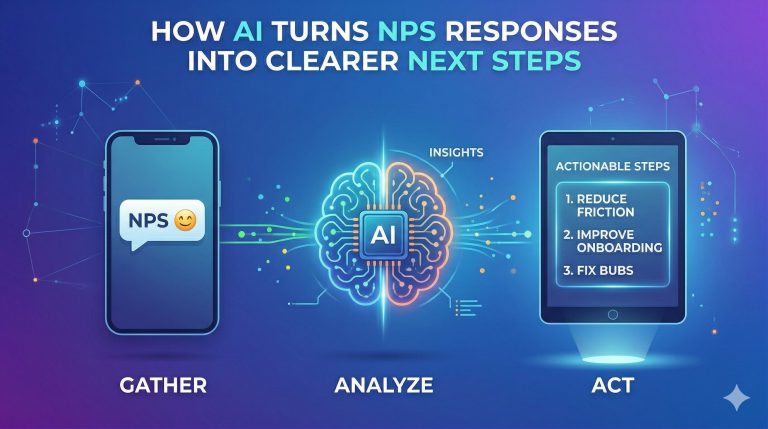
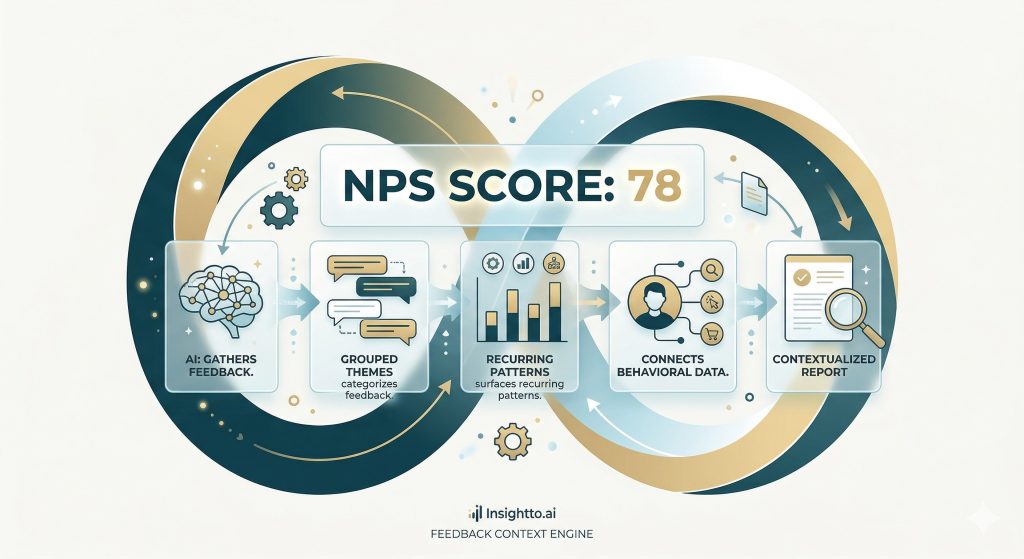
That is where AI and products like Insightto.ai start to help. Not by changing the basic survey question, but by improving timing, surfacing patterns in comments, and connecting scores to surrounding context so the team has a better chance of understanding what the number is actually pointing to.
That does not make NPS less simple. It makes it less isolated.
And that may be the more realistic future for the metric. Not a grand reinvention, but a better surrounding system that allows teams to use it with more precision and less guesswork.