Unhappy customers are not always obvious.
Some are. They complain directly, leave very low scores, or write messages that make the problem impossible to miss. But many do something quieter. They revisit the same pages. They stall. They drift. They leave feedback that sounds flat rather than openly angry.
Nothing about those signals looks dramatic on its own.
Slow response is often a visibility problem
By the time a team formally recognizes the customer as unhappy, the relationship may already have weakened more than anyone realized.
This is why simple advice like “respond faster” is not enough. Speed matters, but only if the team can tell what it is responding to. Otherwise you end up replying quickly to a problem you have not yet understood.
A lot of slow response is really a visibility problem.
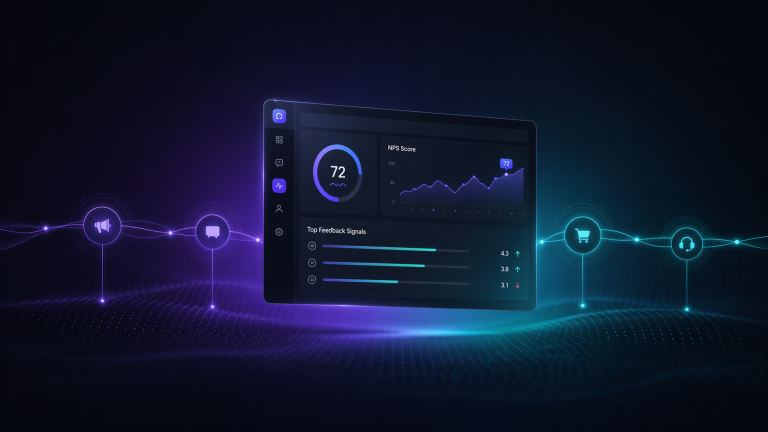
The signals are there, but they are scattered. A low score sits in one place. A support note sits somewhere else. Behavioral hesitation shows up in another tool. A customer comment may hint at frustration without saying exactly what went wrong. Even a careful team can lose time trying to piece that together.
AI helps surface dissatisfaction before it becomes obvious
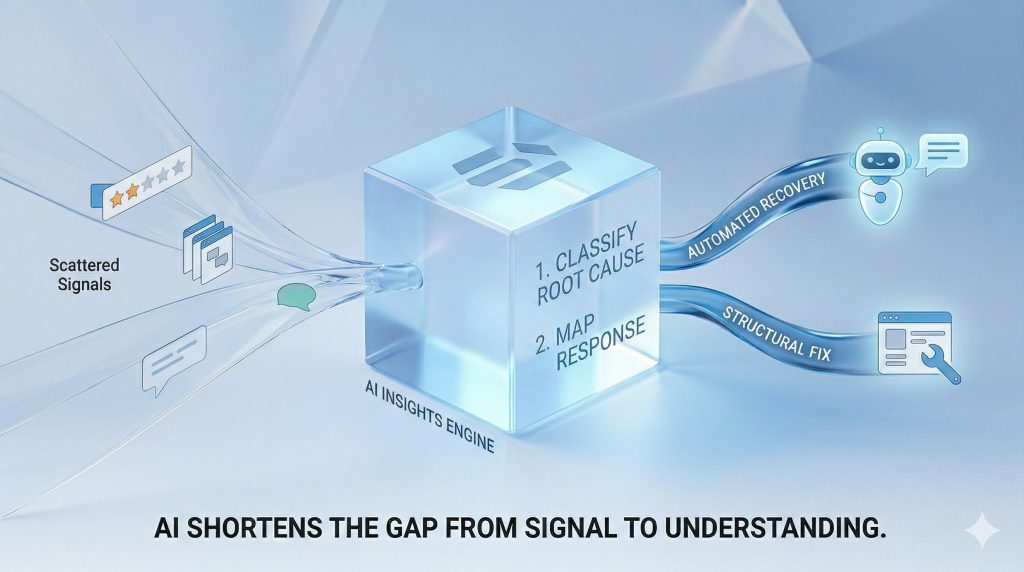
This is where AI becomes useful in a very practical way.
A single weak signal is easy to ignore. A repeated visit pattern may not mean much by itself. A short negative comment can feel too vague to escalate. But once several of those things start showing up around the same part of the journey, the shape of the problem changes.
AI can help surface that pattern earlier.
That matters because the earlier dissatisfaction becomes visible, the better the chance of responding while the relationship is still recoverable.
Faster response starts with better classification
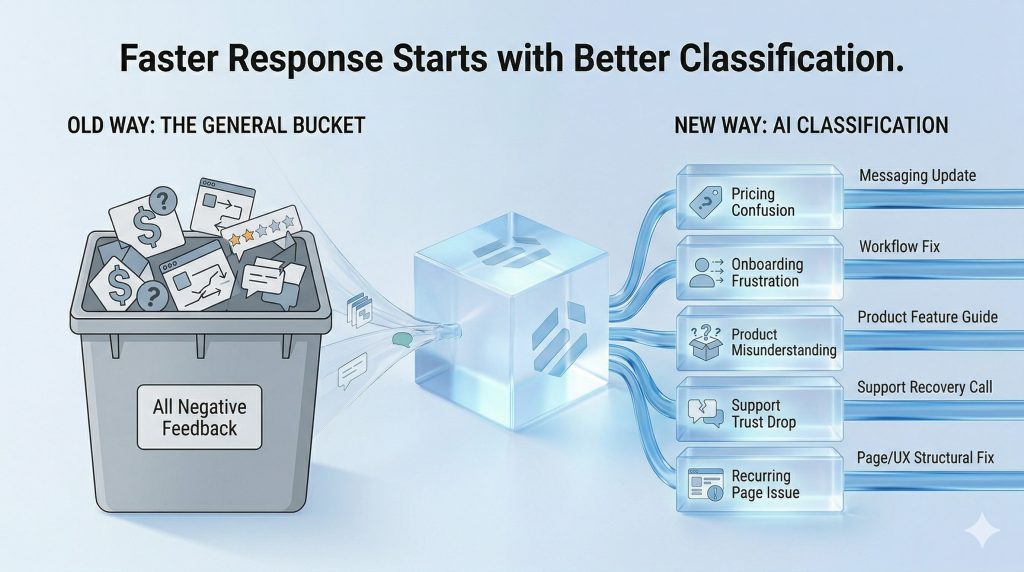
Not every unhappy customer is unhappy for the same reason.
Someone confused by pricing does not need the same treatment as someone frustrated by onboarding. A visitor who never understood the product is different from a customer whose trust dropped after a support interaction. A recurring page-level issue is different again.
If teams put all of those things into one bucket called “negative feedback,” they lose time and often miss the real pattern.
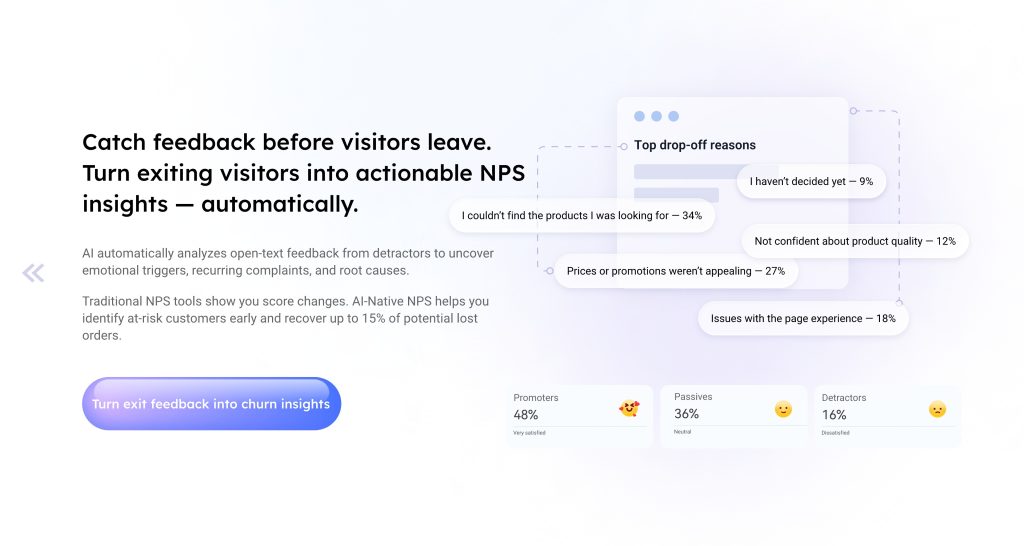
AI helps reduce that blur. It can show whether dissatisfaction is isolated or recurring, whether it clusters around a stage in the journey, and whether the right next move looks more like direct follow-up or structural change.
The best response is not always outreach
This distinction matters because not every negative signal should trigger the same action.
Some problems should be handled person by person. Others should be fixed once at the source.
If several people are getting stuck at the same point, leaving similar low-score signals, or showing the same hesitation pattern, the better response may not be outreach at all. It may be a change to the page, the flow, the messaging, or the moment when feedback is being requested.
That is why faster response should not be defined too narrowly. A quick reply is not automatically a useful response.
The real value is earlier understanding
What matters more is shortening the time between signal and understanding.
Once that gap gets smaller, the quality of response usually improves on its own. Teams can tell whether they are looking at a support recovery case, a UX issue, a messaging problem, or a broader journey problem that needs structural attention.
That is the kind of speed that actually helps.
Why this fits products like Insightto.ai
This is also where a tool like Insightto.ai has a stronger, more believable role.
Its value is not just in collecting feedback. It is in helping teams notice dissatisfaction closer to where it forms, connect it to the surrounding journey, and decide more quickly whether they are looking at a recoverable customer issue or a broader experience problem.
That is usually where better recovery begins.