NPS usually disappoints when people expect it to do too much
NPS has a strange reputation.
It is one of the most widely used customer metrics, and one of the easiest to argue about. Some teams still treat it like a shorthand for loyalty. Others have written it off as too blunt to be worth much. Both reactions tend to miss the point. NPS is useful, but its value is narrower than many companies want it to be.

A lot of the frustration around NPS starts before a survey is even sent. The metric gets loaded with too many expectations. Teams want it to tell them whether loyalty is strong, whether customers are happy, whether the product is getting better, and whether churn risk is rising. Once a single question is expected to answer all of that, it is bound to feel inadequate.
That does not mean NPS is useless. It means it is being asked to do the wrong job.
Used well, NPS is not a full explanation of the customer relationship. It is a simple signal. It can show that sentiment may be shifting. It can help surface where something feels off. It can give teams a shared number to track over time without much complexity.

That is a smaller role than many people want from it. It is also the role it handles best.
The metric is often blamed for problems created by the program around it
When teams say their NPS program is not telling them much, the issue is often not the score itself.
Usually the weakness sits in the setup. Surveys go out on a rigid schedule. Results are rolled up into one average. Comments are skimmed but not really analyzed. Responses are disconnected from the part of the journey that shaped them. By the time someone looks closely, the context is already gone.

In that kind of program, even a decent signal starts to feel vague.
This is why criticism of NPS can sometimes be misleading. What sounds like a problem with the metric is often a problem with how little context surrounds it. Teams are looking at a result after the fact and expecting the number to explain itself.
It rarely can.
A simple metric still has practical value
Part of why NPS has lasted so long is that businesses still need simple things they can use consistently.
Most organizations do not operate with perfect measurement systems. Different teams own different parts of the customer experience, and not everyone is going to work from a complicated framework every week. A lightweight metric has an advantage in that environment. It is easy to repeat, easy to understand, and easy to share across functions.
That alone is not a reason to overrate it. But it is a reason not to dismiss it too quickly.
A score does not have to be deep to be useful. Sometimes it is enough that it helps a team notice movement that might otherwise stay buried inside support queues, churn reports, or scattered customer comments.
The mistake is treating the score like an explanation
Where teams get stuck is in the jump from signal to story.
A drop in NPS might reflect onboarding friction. It might point to a support issue, a pricing concern, a product change, or a broken expectation. A stable score may look healthy while one part of the journey is quietly getting worse. The number can tell you that something may deserve attention. It cannot explain the full reason on its own.
That is why NPS works better when it sits next to other inputs.
Comments matter. Timing matters. Customer segment matters. Recent behavior matters. Support history matters. Once those things are visible, the score becomes easier to interpret. Without them, teams tend to fill in the gaps with assumptions.
That is usually where NPS starts feeling thinner than it needs to.
Better teams use it with less drama
The companies that get value from NPS are often the least theatrical about it.
They do not treat it as a trophy when it rises or a crisis when it falls. They use it as one input in a broader understanding of the customer experience. They look for patterns, not just movement. They care about where responses are coming from and what customers are actually saying.
In practice, that usually looks like this:
- asking for feedback closer to meaningful customer moments
- reviewing comments alongside the score
- comparing patterns across segments or journey stages
- checking whether survey feedback matches what other teams are seeing
- using the result to decide what deserves follow-up
None of that is especially flashy. But it is usually the difference between a metric that sits in reporting and one that helps guide action.
Recommendation is not the same thing as loyalty
This is another place where teams can get sloppy.
NPS is often treated as a direct measure of loyalty, but loyalty is more complicated than that. Some customers stay because they trust the company. Some stay because switching is inconvenient. Some are satisfied enough to continue but not enthusiastic enough to recommend. Others may recommend a brand and still leave later for reasons that have little to do with sentiment.
So yes, NPS can tell you something about relationship strength. But it cannot fully explain why customers stay, expand, advocate, or leave.
Once that is clear, the metric becomes easier to use properly. It stops being a grand statement about loyalty and becomes what it probably should have been all along: a lightweight signal that helps teams pay closer attention.
Why context matters more now
The biggest weakness in many NPS programs is not that the question is too simple. It is that the answer arrives stripped of context.
A detractor score means much more if you know what happened just before it. Did the customer hit a frustrating onboarding step? Spend too long on a pricing page? Reach support after something broke? Experience a delivery delay? Without that surrounding detail, teams are left interpreting sentiment from a distance.
That is part of why feedback tools are becoming more useful when they connect survey responses to customer behavior and journey stage. The point is not to make NPS sound more advanced than it is. The point is to make the signal easier to understand while it is still fresh enough to act on.
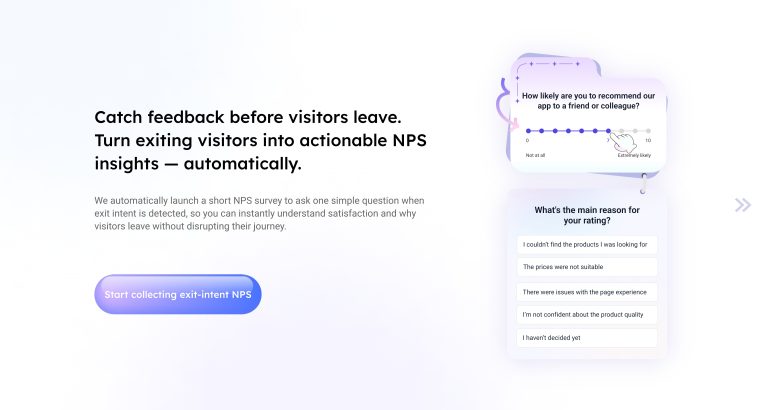
That is where a tool like Insightto.ai fits naturally. It helps place feedback closer to the customer moment and gives teams more context around what may have shaped the response.
Final thought
NPS becomes much easier to work with once teams stop asking it to do too much. It will not explain loyalty in full, and it will not tell you exactly what to fix. But it can still help you notice when customer sentiment is changing and where deeper investigation is worth the effort.
That is not a grand role. It is just a useful one.