Why churn prediction often stalls right after scoring
Many churn programs don’t fail at detection. They fail at execution.
A risk score lands in a dashboard, gets labeled “high,” and then sits there while teams debate what it means. Customer Success wonders whether outreach is premature. CX sees possible journey friction. Product suspects adoption issues. No one is clearly wrong, but no one owns the first move.
When that delay becomes routine, model quality stops mattering as much as teams think. The model may be technically sound and still operationally weak because intervention arrives late or unfocused.
Two patterns usually sit underneath this:
- Alerts appear too close to the point of churn to allow meaningful recovery
- Outputs are too compressed to guide action across teams
If you want churn prediction to be useful, the output has to travel beyond analytics and survive handoff.

Structured signals are essential, but incomplete
Behavioral and product telemetry should remain the foundation. That’s where early movement shows up.
Most teams already use a familiar base set: login frequency changes, feature depth, onboarding completion, support volume and reopen patterns, billing events, usage recency, and expansion/contraction signals. These inputs are reliable because they are measurable and consistent over time.
But structured data usually tells you what changed, not how customers are interpreting that change.
A usage drop can mean poor fit, confusion, unresolved support fatigue, shifting priorities, or pricing pressure. Those causes look similar in the model and very different in practice. If you can’t separate them, you end up with blunt interventions: broad outreach, generic save plays, and a lot of effort spent on the wrong accounts.
Feedback improves confidence, not just context
Unstructured feedback adds the missing layer: why confidence in the prediction should rise, fall, or stay uncertain.

Survey comments, NPS follow-ups, CSAT notes, and in-product responses can clarify whether behavioral decline is noise or a meaningful warning. If usage softens while comments repeatedly point to complexity or blocked outcomes, risk confidence should move up. If usage is mixed and feedback is neutral or improving, the same risk score deserves a more cautious treatment.
That distinction matters because most churn workflows break under binary escalation. Every alert looks urgent, so teams either overreact or stop trusting the queue.
A practical input stack usually includes three layers:
- Behavior layer: activity decline, journey stalls, adoption regressions, support interaction patterns
- Feedback layer: sentiment direction, recurring friction themes, language indicating confusion or intent to reduce
- Account context layer: lifecycle stage, plan profile, implementation milestones, recent commercial changes
The goal is not to maximize inputs. It is to make outputs interpretable enough for decisions.
Design outputs for operators, not only analysts
Teams often spend months improving model architecture and very little time on decision design. That imbalance creates beautiful scoring and weak execution.

Operationally, a single blended score is often too opaque. Weighted signal groups are easier to use because people can see why risk is elevated and where evidence is thin. If behavior deterioration is strong but feedback is contradictory, confidence should drop explicitly rather than getting averaged away.
Confidence bands help here, especially for non-technical owners reviewing queues daily.
For example:
- High risk / high confidence: clear behavioral decline with reinforcing negative feedback themes
- High risk / low confidence: concerning telemetry, weak or mixed qualitative evidence
- Moderate risk / high confidence: early decline with consistent friction language across touchpoints
This structure reduces two expensive mistakes: aggressive escalation on shaky evidence, and delayed action on credible early warnings.
Route by cause pattern, with clear ownership and cadence
Risk level alone is a poor routing rule. Cause pattern is usually more useful.

A workable operating model looks like this:
Weekly ownership rhythm
- RevOps / Data publishes scored accounts with reason clusters and confidence band
- CS leadership triages account-level interventions
- CX lead reviews communication/journey-related patterns
- Product ops or PMM reviews recurring product friction clusters
Handoff rules
- Customer Success owns first touch for account-specific recovery paths
- CX owns journey/message fixes when confusion patterns repeat across segments
- Product owns structural fixes when the same friction signature appears across multiple at-risk cohorts
Timing expectations
- High-risk/high-confidence accounts: same-day or next-business-day owner assignment
- Moderate-risk/high-confidence: scheduled review in weekly risk standup
- Low-confidence alerts: monitor until confirming signals appear, rather than forcing immediate outreach
Without this kind of explicit operating layer, teams treat predictions as insight artifacts instead of intervention triggers.
Measure intervention quality, not just model performance
Precision, recall, and lift still matter. They are not enough.
If your teams cannot show what happened after routing, the workflow is incomplete. Minimum measurement should cover:
- time from alert to owner assignment
- time from assignment to first action
- intervention type selected vs. reason cluster
- short-cycle outcome (stabilized usage, response received, issue confirmed, no action taken)
- reason-code drift over time to catch stale routing logic
Also set a review cadence. Monthly calibration is usually the floor: revisit weights, inspect false positives by reason band, and audit whether teams are bypassing the prescribed routing path.
If operators don’t trust the confidence layer, they’ll quietly ignore it and return to intuition.
Final thought
Churn prediction becomes genuinely actionable when teams can move from risk detection to intervention choice without a long translation step. Structured signals provide early visibility. Feedback makes that visibility usable.
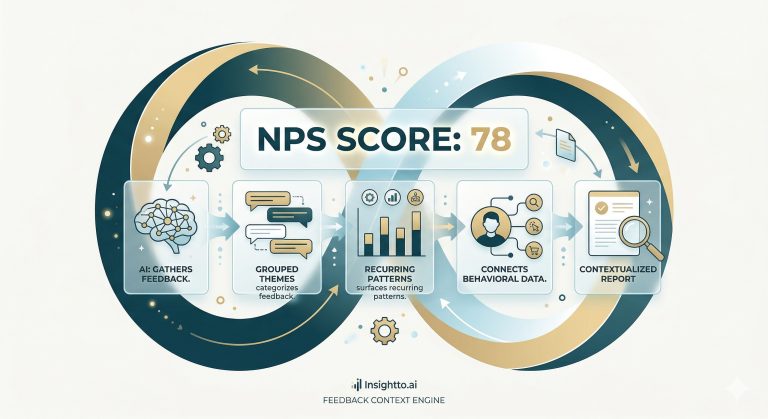
Keep both in the same loop, define ownership before alerts go live, and review routing quality as rigorously as model quality. Near that handoff layer, platforms like Insightto.ai can help teams connect behavior signals with live customer feedback so CX, Success, and Product are acting on the same evidence rather than parallel interpretations.