The Insightto Blog

Strategies, insights, and trends for better customer journeys

More from the blog

Experience Management

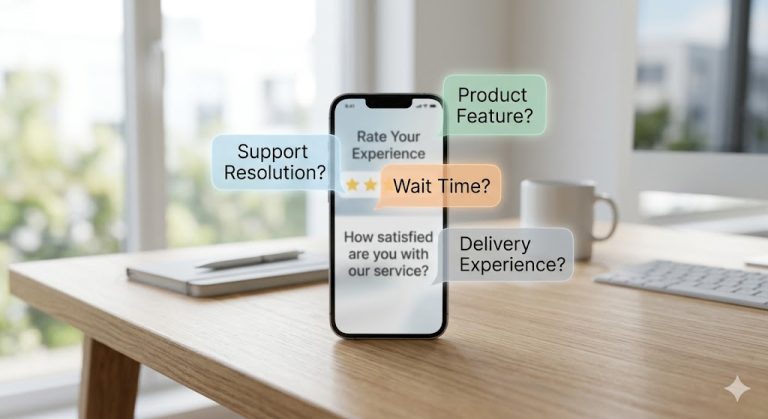
CSAT Works Best When the Team Knows Which Moment It Is Measuring

CSAT can be a useful metric, but only when the team is clear about what the customer is actually rating. The moment behind the score matters more than the neatness of the dashboard. In practice, CSAT tends to work when it stays close to one interaction, one fresh memory, and one team that can actually do something with the answer. CSAT looks simple, and that is usually where the sloppiness starts It is easy to set up. One short question. Quick response. Easy to trend. Compared with bigger feedback programs, it feels lightweight and manageable. That is part of the appeal. It is also why teams get loose with it. A lot of weak CSAT programs are not broken because the question is bad. They are weak because nobody stays disciplined about what the customer is meant to be rating. The survey goes out, the scores come back, and only later does the team realize they were never fully aligned on the moment behind the answer. That creates a very familiar kind of confusion. If the moment is fuzzy, the score is fuzzy There is no real way around that. What exactly is the customer responding to? the support resolution itself? the wait before the resolution? the handoff between teams? the delivery experience? frustration that started earlier and only surfaced now? a blended impression of the last few interactions? Once the answer turns into “probably some mix of those,” the metric has already started to lose usefulness. You can still report on it. You can still compare trends. But the team will spend too much time debating what the number really refers to. This is what shows up in actual reviews A lower score comes in. Support says the ticket was handled correctly. Operations says the delay happened earlier. Product thinks the frustration started before the customer ever contacted support. None of them is necessarily wrong. The problem is that the measurement is doing too many things at once. That is why vague CSAT becomes annoying so quickly. It creates visibility, but not much clarity. The number exists. The action path does not. Narrower usually works better This sounds less ambitious, which may be why teams resist it. Still, tighter scope is what makes CSAT more usable. A resolved support conversation is a decent example. So is a delivery event. A setup step. An onboarding checkpoint. Something the customer can reasonably hold in mind as one thing, even if the experience around it was not perfect. Once that is true, the score gets easier to trust. So do the comments. You are no longer trying to figure out whether “frustrating” refers to this interaction, the one before it, or the whole string of events the customer has bundled together. A quick test Before putting too much weight on a CSAT flow, it helps to ask: Can we name the exact moment being measured? Is the customer likely to remember that moment clearly enough? Can one team act on the answer without a long interpretive debate? If those answers are weak, the setup is probably weak too. Context helps, but it should not have to rescue the metric A good CSAT setup still needs context. If a support score is poor, it helps to know whether the customer had to repeat themselves. If a delivery score slips, you want to know whether the problem was delay, damage, or communication. If a user gives poor feedback after onboarding, it matters whether they got stuck once or kept hitting the same step. But there is a difference between context making the answer more useful and context having to save a vague measurement. Teams blur that line all the time. The better version is not complicated: ask about one real moment, then keep just enough surrounding information with the answer that someone can act on it without too much guesswork. The mistakes are usually the usual ones Most broken CSAT setups drift into one or two familiar problems: the survey goes out after too much has already happened the team wants transactional feedback, but the answer picks up broader frustration the score is tracked, but nobody is clear on the follow-up path the shortness of the question gets mistaken for precision That last one is especially common. A short question does not make a measurement moment well defined. If a tool like Insightto.ai helps tie the response back to the workflow, page, or interaction around it, that is useful enough. Not because it makes CSAT sound more strategic than it is. Just because it cuts down the guessing after the answer shows up. One practical rule is probably enough here: If you cannot finish the sentence “This CSAT score is about…” without immediately qualifying it, the setup likely needs work.
NPS in Practice

Smarter NPS Starts With Better Timing

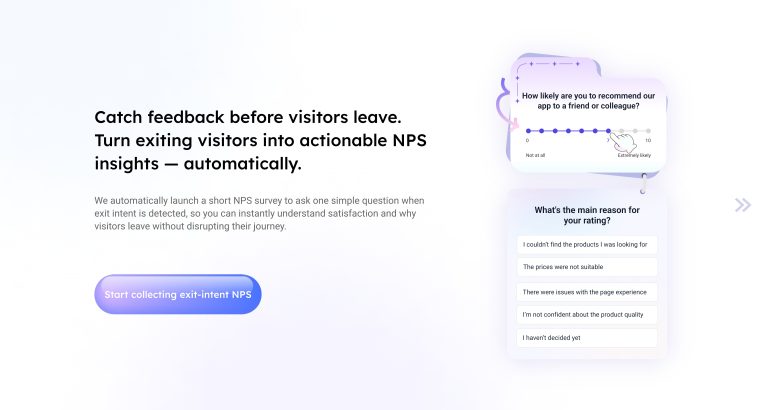
NPS often feels weak not because the question is flawed, but because teams ask it at the wrong moment. Better timing gives feedback more context, makes responses more specific, and helps teams understand what customers were reacting to. AI is useful when it helps trigger surveys around meaningful moments instead of on arbitrary schedules. When teams say NPS is not telling them much, they usually blame the question. The score feels broad. The feedback sounds vague. The responses are hard to use. So the assumption is that the metric itself is too limited to be worth much. That is not always wrong. But a lot of weak NPS programs start failing before anyone reads the result. The survey was sent at the wrong moment. Timing changes what the answer means That matters more than most teams admit. Ask too early and the customer has not experienced enough to answer with any substance. Ask too late and the response gets filtered through whatever happened afterward, or through a general impression that no longer maps cleanly to the moment you wanted to understand. The score still arrives either way. What disappears is the context that would have made it useful. People do not usually answer NPS in some abstract, brand-level way. They answer from what still feels recent enough to shape their judgment. In a digital journey, that may be a pricing page, a repeat visit, a signup attempt, a support interaction, or a point where the experience suddenly felt heavier than expected. When the survey lands close to that moment, the signal gets sharper. The number is easier to interpret. The written feedback usually becomes more specific too. Poor timing creates predictable problems Bad timing tends to create the same kinds of distortion. One is that the response becomes detached from the experience you were trying to measure. Another is that feedback gets generic. A third is delay: by the time dissatisfaction becomes visible, the customer may already be cooling off or leaving. There is also a quieter problem. Poor timing can make a feedback program look healthier than it really is. Teams may be collecting valid scores while missing the exact moments where confidence is breaking down. This shows up a lot when surveys are sent on fixed schedules simply because fixed schedules are easy to manage. Quarterly sends look neat on an internal calendar. Customer judgment does not form on a neat calendar. In ecommerce and page-based journeys, timing is part of the method This gets even more obvious in ecommerce and product-led journeys. A visitor who just spent time on a pricing page is in a very different mental state from someone who bounced off the homepage. A person who came back three times has more formed judgment than someone who barely engaged once. A user who just completed a meaningful step can answer in a grounded way. Someone who has not yet reached the decisive moment usually cannot. This is where timing stops being an operational detail and becomes part of the method. Better timing does not change the NPS question itself. It puts the question closer to the experience that shaped the answer. AI helps make timing less arbitrary This is one of the more grounded ways AI improves feedback programs. The value is not that AI makes the survey smarter in some magical sense. The useful part is that it helps teams stop triggering outreach at arbitrary moments. Instead of sending surveys because the calendar says it is time, teams can ask when behavior suggests the customer has actually reached a meaningful point. That may be after a repeat visit, after visible hesitation, after a high-intent page sequence, or after a key step in evaluation. Once timing improves, interpretation improves too. A low score after several pricing visits tells one story. A low score after a rough onboarding moment tells another. The tighter the link between response and experience, the less guesswork the team has to do later. Better timing changes the role of NPS When teams improve timing, NPS starts functioning differently. It stops being just a recurring health score and becomes more of an operational signal. The conversation shifts from “What is our score this month?” to “What are people reacting to, and where is that reaction forming?” That is a much more useful question. Where a product like Insightto.ai fits This is also where a tool like Insightto.ai becomes relevant in a very practical way. If teams can trigger surveys at moments that actually matter, read feedback next to page journey context, and see when hesitation is building, then NPS becomes more informative without becoming more complicated. A lot of teams do not need a new metric. They need better timing.
AI for NPS and Feedback / Experience Management

What AI Changes in Experience Management

AI is changing experience management less by replacing surveys or metrics than by making weak signals easier to detect earlier. Instead of waiting for problems to show up clearly in retrospective reporting, teams can connect feedback, behavior, and operational context closer to the moment where friction forms. That makes the work less episodic and more operational. Experience management used to feel simpler than it does now. You sent surveys, collected scores, reviewed comments, tracked trends, and used those signals to decide what needed attention. It was mainly a measurement discipline. Even when the work was imperfect, the basic logic was easy to follow. That logic still matters. It is just no longer enough by itself. The old model was built around retrospection The problem is not that teams lack customer feedback. In most cases, they have plenty of it. The problem is that feedback arrives late, lives in different systems, and often gets separated from the customer moment that produced it. By the time a pattern becomes obvious in a monthly report, the experience behind it may already have repeated many times. Traditional experience management was built around looking back and asking what customers felt. That made sense when touchpoints were fewer and expectations were slower. It is harder to rely on that model now. Customer experience does not form in one or two obvious places anymore. It takes shape across product pages, pricing pages, onboarding steps, support interactions, repeat visits, and post-purchase touchpoints. In many cases, what weakens trust is not one dramatic breakdown, but a series of smaller frictions. AI helps teams see weak signals sooner This is where AI changes the function in a way that is actually useful. Most organizations already have the raw signals they need. Survey feedback exists. Behavioral patterns exist. Support data exists. Journey friction exists. The difficulty is that these signals sit in different places, and by the time a person pulls them together manually, the pattern may already be old. AI helps shorten that lag. It can surface repeated themes in feedback, connect sentiment to surrounding behavior, and make it easier to spot where frustration or uncertainty is starting to gather. That does not make the interpretation perfect, but it makes the work less blind. Experience management becomes less episodic That matters most when the signals are weak in isolation. One low score may not tell you much. One abandoned step may not either. But when similar signals start gathering around the same part of the journey, the business gets an earlier read on what is changing. Once that happens, feedback stops behaving like a delayed summary and starts becoming more of an operating signal. The team stops asking only, “How did we do?” and starts asking, “Where is the experience starting to weaken?” That is a different kind of question. It is less about retrospective reporting and more about intervention. Metrics do not disappear, but they become less isolated Metrics like NPS, CSAT, and CES do not disappear in this model. If anything, they become more useful because they stop being read alone. A score means more when it sits next to behavior. A written comment is easier to act on when the surrounding journey is visible. A trend becomes easier to trust when it is not detached from the operational reality around it. The metrics stay the same. The interpretation gets more grounded. The function becomes more operational This also changes what experience management looks like inside the business. Instead of ending mainly in reporting cycles, the work moves closer to active friction, active decisions, and emerging risk. CX teams can see where frustration is building. Growth teams can see where hesitation is affecting conversion. Product teams can connect feedback to specific breakdowns instead of broad sentiment alone. That makes the function feel less delayed and more operational. Why this matters for tools like Insightto.ai This is also why tools like Insightto.ai make more sense in the current environment. The value is not just that they gather feedback. The more interesting part is that they help teams capture and interpret feedback in a way that stays closer to the journey itself. That is what experience teams increasingly need. Final thought AI is not making experience management easy. The work is still messy. Signals are still incomplete. Teams still need judgment. But it is making the function less delayed. And right now, that is a meaningful change.
AI for NPS and Feedback

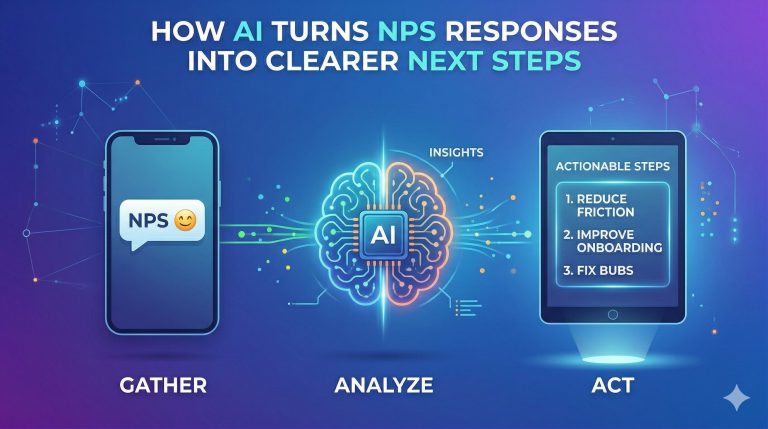
How AI Turns NPS Responses Into Clearer Next Steps

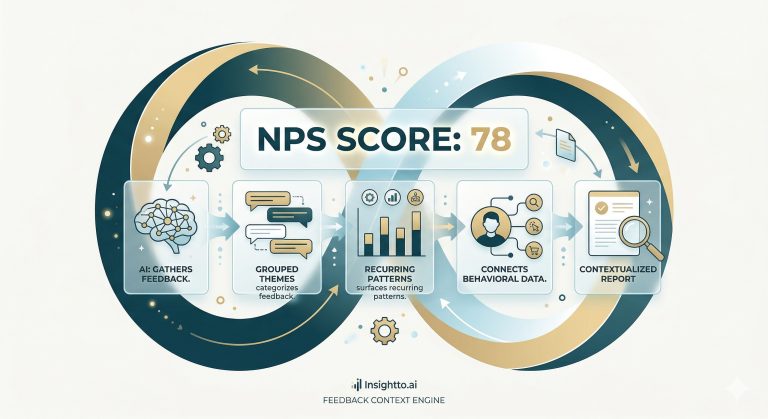
NPS often gives teams a signal before it gives them a clear action. AI becomes useful when it reduces the time spent sorting, grouping, and interpreting messy responses, especially when feedback is read with behavioral context. The real value is not in collecting more input, but in making the path from response to action less blurry. Collecting NPS responses is usually not the hard part. The difficult part starts once the responses arrive. A score dips. Comments accumulate. Everyone can see that something deserves attention, but that does not mean the team knows what to do next. This is where a lot of feedback programs start feeling heavier than they should. The problem is rarely a lack of input. Most teams already have plenty of it. The problem is that the input arrives in a form that does not make prioritization easy. A score gives direction, not a decision The score tells you movement happened. It does not tell you what caused it. A drop could reflect weak messaging, poor timing, onboarding friction, pricing hesitation, a support issue, or something broader in the journey. The number is useful because it shows that sentiment shifted. It is limited because it does not tell you where to begin. That is often where the slowdown starts. Teams know something changed, but not what deserves attention first. Open-text feedback contains the value, but also the mess The written responses usually contain the real signal. Customers say what felt unclear, frustrating, useful, or unexpectedly good. But they do not say it in neat internal categories. They describe symptoms. They compress experience into a few lines. Sometimes several issues get folded into one short comment. One person says the page felt confusing. Another says they were not sure what to do next. Someone else says there was too much information. Another leaves a low score with almost no explanation at all. Taken one by one, these comments are useful but messy. Read together, they may all be pointing to the same friction. AI helps by making patterns visible earlier This is where AI becomes genuinely useful. Not because it magically understands customers better than the team does, and not because it replaces interpretation. The practical value is simpler than that. AI can help surface patterns sooner than a person working through a long list of responses by hand. It can group comments that sound different but are circling the same issue. It can reduce the amount of manual sorting that happens before the real discussion even begins. That may not sound dramatic, but it matters because the biggest delay in acting on feedback is often the time it takes to get the signal into a shape that feels clear enough to trust. Context turns vague feedback into usable direction This gets even more useful when feedback is read alongside behavior. A low score attached to repeated pricing-page visits tells a different story from a low score that follows a rough onboarding moment. A vague comment about clarity becomes much more informative when you can see what the person had just been doing. If someone says the experience was unclear after revisiting the same part of the journey several times, the team suddenly has something more concrete than a general complaint. That is often the missing piece in feedback programs. The survey response exists, but it is disconnected from the moment that produced it. Not every response should trigger the same action Not every low score deserves the same response. Some comments call for direct follow-up. Some point to recurring content or UX issues. Some belong to a broader pattern that should be handled structurally rather than one customer at a time. A few may reflect poor-fit users rather than something the business should rush to optimize around. Without better sorting, those distinctions are easy to miss. AI helps because it shortens the distance between response and judgment. It helps teams see which comments cluster together, which signals are repeating, and which issues are strong enough to deserve action first. The real win is a shorter path from feedback to judgment The best outcome is not “more analysis.” It is clearer action. Once feedback becomes easier to group, interpret, and relate back to the journey, the next step becomes much less foggy. The team can tell whether the issue belongs to content, product, onboarding, pricing explanation, support, or response timing. That makes the conversation move faster and with less guesswork. Why this matters for Insightto.ai This is also where products like Insightto.ai become more compelling. The useful part is not just that they help teams collect feedback. The stronger story is that they help place survey responses closer to the journey they came from, surface patterns earlier, and move from “we have responses” to “we know what deserves attention.” That is what most teams are actually looking for. Clearer next steps.
AI for NPS and Feedback / Experience Management

How AI Helps Teams Respond Faster to Unhappy Customers

eams are often slow to respond to unhappy customers not because they do not care, but because the signals around dissatisfaction are weak and scattered. AI helps when it makes those patterns easier to see earlier, especially across feedback, hesitation, and page-level behavior. The goal is not just faster replies, but faster understanding of what kind of problem the customer is actually facing. Unhappy customers are not always obvious. Some are. They complain directly, leave very low scores, or write messages that make the problem impossible to miss. But many do something quieter. They revisit the same pages. They stall. They drift. They leave feedback that sounds flat rather than openly angry. Nothing about those signals looks dramatic on its own. Slow response is often a visibility problem By the time a team formally recognizes the customer as unhappy, the relationship may already have weakened more than anyone realized. This is why simple advice like “respond faster” is not enough. Speed matters, but only if the team can tell what it is responding to. Otherwise you end up replying quickly to a problem you have not yet understood. A lot of slow response is really a visibility problem. The signals are there, but they are scattered. A low score sits in one place. A support note sits somewhere else. Behavioral hesitation shows up in another tool. A customer comment may hint at frustration without saying exactly what went wrong. Even a careful team can lose time trying to piece that together. AI helps surface dissatisfaction before it becomes obvious This is where AI becomes useful in a very practical way. A single weak signal is easy to ignore. A repeated visit pattern may not mean much by itself. A short negative comment can feel too vague to escalate. But once several of those things start showing up around the same part of the journey, the shape of the problem changes. AI can help surface that pattern earlier. That matters because the earlier dissatisfaction becomes visible, the better the chance of responding while the relationship is still recoverable. Faster response starts with better classification Not every unhappy customer is unhappy for the same reason. Someone confused by pricing does not need the same treatment as someone frustrated by onboarding. A visitor who never understood the product is different from a customer whose trust dropped after a support interaction. A recurring page-level issue is different again. If teams put all of those things into one bucket called “negative feedback,” they lose time and often miss the real pattern. AI helps reduce that blur. It can show whether dissatisfaction is isolated or recurring, whether it clusters around a stage in the journey, and whether the right next move looks more like direct follow-up or structural change. The best response is not always outreach This distinction matters because not every negative signal should trigger the same action. Some problems should be handled person by person. Others should be fixed once at the source. If several people are getting stuck at the same point, leaving similar low-score signals, or showing the same hesitation pattern, the better response may not be outreach at all. It may be a change to the page, the flow, the messaging, or the moment when feedback is being requested. That is why faster response should not be defined too narrowly. A quick reply is not automatically a useful response. The real value is earlier understanding What matters more is shortening the time between signal and understanding. Once that gap gets smaller, the quality of response usually improves on its own. Teams can tell whether they are looking at a support recovery case, a UX issue, a messaging problem, or a broader journey problem that needs structural attention. That is the kind of speed that actually helps. Why this fits products like Insightto.ai This is also where a tool like Insightto.ai has a stronger, more believable role. Its value is not just in collecting feedback. It is in helping teams notice dissatisfaction closer to where it forms, connect it to the surrounding journey, and decide more quickly whether they are looking at a recoverable customer issue or a broader experience problem. That is usually where better recovery begins.
AI for NPS and Feedback

Why NPS Still Matters — When You Use It Well

NPS still has value, but only when teams stop expecting too much from it. It works best as a lightweight directional signal, not as a full explanation of customer experience. The metric becomes much more useful when it is read alongside timing, written feedback, and customer behavior. NPS has been around long enough that many people have developed a fixed opinion about it. Some still treat it as the default way to measure customer loyalty. Others dismiss it as too simplistic to be useful. Neither reaction is entirely wrong. NPS is simple, and that simplicity is part of both its strength and its limitation. What matters is not whether NPS is universally good or bad. What matters is how it is being used. When teams expect it to explain everything, it disappoints. When they use it carefully, in the right context, it can still be one of the clearest lightweight signals in a customer experience program. NPS is not supposed to do every job A lot of frustration with NPS comes from asking it to carry too much weight. It is a recommendation question, not a complete diagnostic system. It can tell you something about loyalty, perception, and the overall direction of the relationship. It cannot, on its own, tell you the full reason behind a customer’s score, nor can it replace journey analysis, support data, product analytics, or direct research. When teams forget that, NPS starts looking shallow. They expect one score to explain a complicated experience, and when it does not, they conclude the metric itself is flawed. But that is not really the test. The more useful question is whether NPS can help a team notice changes in customer sentiment, compare patterns over time, and identify where deeper investigation is needed. Used that way, it still holds up surprisingly well. Simplicity is part of why it survives One reason NPS continues to matter is precisely because it is simple. It is easy to deploy. Easy to understand. Easy to repeat across time. That does not make it sophisticated, but it does make it usable across teams that would never adopt a more complex experience measurement model consistently. That matters in real organizations. Most companies are not operating with ideal research conditions. They need signals that can be collected regularly, interpreted without too much ceremony, and shared across product, support, CX, and leadership without a long explanation attached. NPS is often good enough to serve that role, provided no one mistakes it for the whole picture. Its value is not that it captures every nuance. Its value is that it gives teams a relatively consistent signal they can place next to other evidence. The metric becomes weak when it is treated in isolation Where teams get into trouble is not usually the existence of NPS. It is the way they isolate it. A score without context is easy to overread. A drop in NPS may reflect delivery issues, support delays, a product change, a broken expectation, or a completely external factor. A healthy score may hide problems that are building in one stage of the journey but not yet visible in the average. This is why mature teams rarely look at NPS alone. They look at comments, timing, journey stage, support patterns, repeat purchase behavior, and other surrounding signals. The number on its own is rarely enough. The number in context can be quite useful. That distinction matters. Many criticisms of NPS are really criticisms of how lazily it gets implemented. In ecommerce, NPS still has a clear role This is especially true in ecommerce, where customer sentiment often shifts around specific moments rather than broad brand perception alone. A customer may feel very differently after a late delivery than after a smooth return. A repeat buyer may answer differently from a first-time buyer. A support issue may damage trust even if the checkout experience itself was flawless. NPS still matters here because it provides a relatively efficient way to capture how customers are feeling around those moments, provided the timing is chosen carefully and the responses are not stripped away from context. It is not the only feedback mechanism a team needs. But it is still a useful one, especially when the goal is to maintain a lightweight but repeatable view of how customer experience is trending. Good use looks disciplined, not dramatic Teams that use NPS well usually do a few simple things consistently. They do not expect the score to explain everything.They pay attention to timing.They read the comments, not just the number.They compare scores across meaningful parts of the journey.They use NPS as a signal to investigate, not as a final answer. None of this is glamorous. That may be one reason NPS often gets dismissed by people looking for a more advanced-looking framework. But in practice, disciplined use usually matters more than methodological ambition. A simple metric used carefully is often more useful than a more sophisticated one that no team can operate consistently. Where AI and better tooling help The stronger argument for improving NPS is not that the metric needs reinvention. It is that the way teams work around it needs improvement. That is where AI and products like Insightto.ai start to help. Not by changing the basic survey question, but by improving timing, surfacing patterns in comments, and connecting scores to surrounding context so the team has a better chance of understanding what the number is actually pointing to. That does not make NPS less simple. It makes it less isolated. And that may be the more realistic future for the metric. Not a grand reinvention, but a better surrounding system that allows teams to use it with more precision and less guesswork.